

Challenging conservation
23.10.24
This Autumn, SHBT bring you ‘Challenging Conservation’. In this six-lecture series, guest speakers will discuss what happens when conservation is only for meanwhile? Should we, or how should we, reconstruct facsimiles of buildings which have been destroyed? What happens if we build those facsimiles online? How do we conserve the everyday? When shouldn’t we conserve buildings?
In each session of this series of conversations, professionals and thinkers from Scotland and beyond will debate questions designed to challenge the practices of conservation and to interrogate the assumptions that underly them.

Richard Murphy In Conversation: Challenging Conservation
Join SHBT Director Dr Sam Gallacher for an evening in conversation with celebrated architect, Richard Murphy OBE.
Richard is the founder and managing director of award-winning architectural practice Richard Murphy Architects Ltd. His work has ranged from the domestic through to major city centre developments and master-planning; from private housing to two British Embassies. He has undertaken ambitious and creative projects on historic buildings, including Stirling Tolbooth Arts Centre and Dunfermline Carnegie Library & Galleries. Richard is also the author of three books on the Venetian architect Carlo Scarpa (1906-1978).
Drawing on their personal knowledge of buildings from Scotland and further afield, Sam and Richard will explore the philosophy and practice of architectural preservation in a wide-ranging discussion. Do we have a cultural responsibility to progress? When is rebuilding justified? And how might our approaches to conservation – and design – evolve in the future?

How long is now? Meanwhile Uses for Old Buildings
What happens when conservation is only for the time being? A ‘meanwhile use’ for a historic building can last for a weekend, a year, or – in some cases – a decade. What do these interventions look like, and what is their impact on the life of the buildings they occupy?
Hidden Door arts festival transforms Edinburgh’s disused and overlooked spaces into venues for sharing inspiring music, theatre, visual art, film, dance, spoken word, and more. In their 10th birthday year, Festival Director Hazel Johnson looks back at some of the incredible buildings they have opened up to the public – on a temporary basis – from the Market Street vaults, to the old Royal High School and Granton Gasworks.
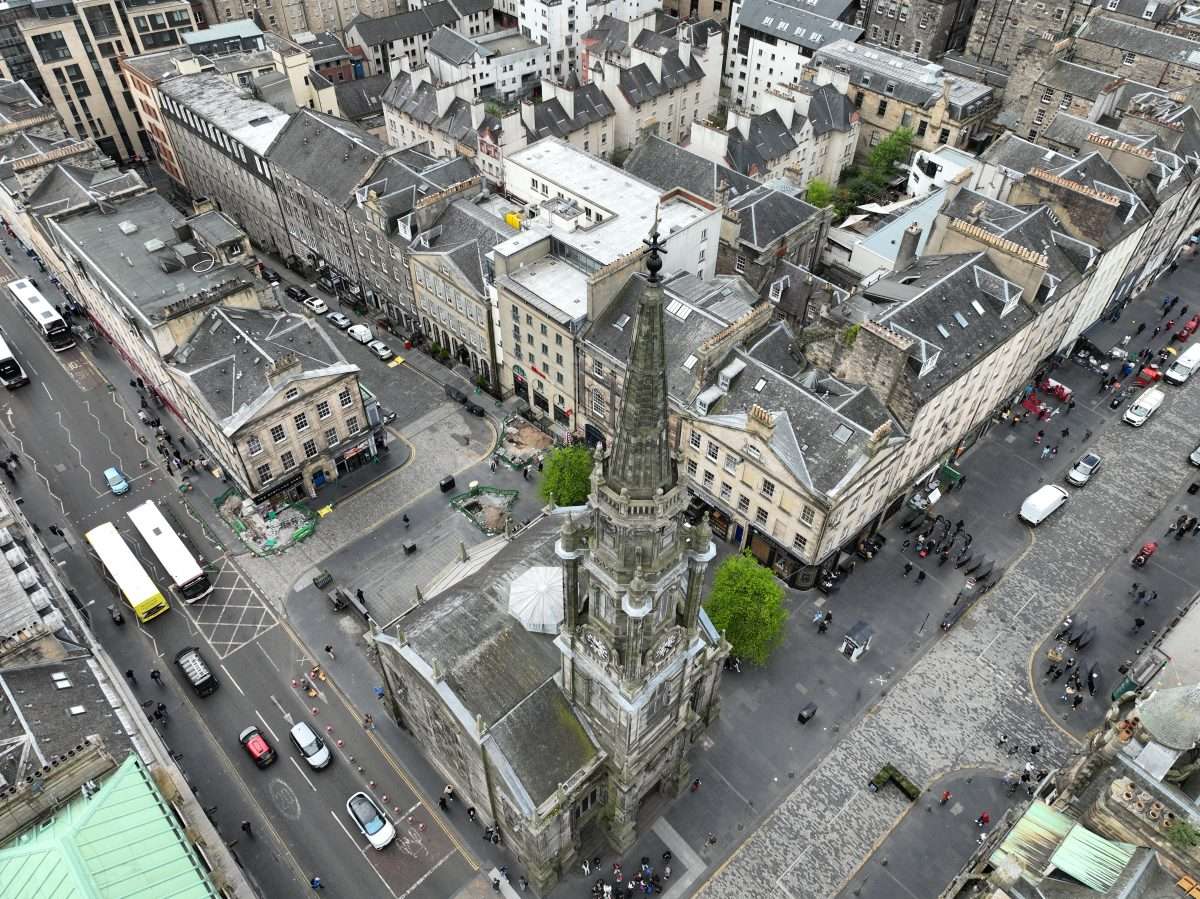
Lynzi Leroy is founder and CEO of social enterprise Scottish Design Exchange, whose most recent retail location is the Tron Kirk Market on Edinburgh’s Royal Mile. As a ‘meanwhile user’ of this Category A-listed building, Lynzi will explore what’s involved in bringing the work of Scottish artists and makers into one of the most significant historic buildings on Edinburgh’s High Street.

The case for reconstruction? Glasgow School of Art & other stories
The loss of a significant building is often taken to be an opportunity to rebuild with a contemporary structure. But when should we, and how should we, attempt accurately to reconstruct buildings which have been destroyed?
Liz Davidson was senior project manager on the Glasgow School of Art Regeneration project from 2014 through to 2022, and is now Project Director at the National Trust for Scotland with responsibility for the repair and conservation of Charles Rennie Mackintosh’s Hill House. She will reflect on the philosophy of the decision to restore after the first fire in 2014 and the much greater losses of the second fire which necessitate a full – at least structural – reconstruction.
Caroline Stanford is in-house Historian at The Landmark Trust, whose scholarly restoration projects have included Auchinleck House and Fairburn Tower (which included the creation of a well-researched, but hypothetical, painted ceiling). Using case studies from Landmark’s work, Caroline will discuss how Landmark arrives at a philosophy of repair for each building it takes on, and consider the pre-conditions that sometimes make facsimile reconstruction acceptable

Digital Space & Place: History & Fantasy for Public Heritage
How do you help a wide public audience imagine and appreciate architecture when the buildings no longer exist? When they can’t be visited, viewed, and experienced?
Glaire Anderson discusses her work as external historian/art historian on Ubisoft’s popular history-themed video game Assassin’s Creed Mirage. Set in 9th century Baghdad, the game’s virtual environment offers an extreme case of digital visualisation for cultural heritage.
Now a ruined shell clinging to the side of the peel above Linlithgow Loch, Linlithgow Palace was once the great pleasure palace of the kings and queens of Scotland. It resounded to music sung by skilled musicians in magnificent surroundings. James Cook’s work brings together scientific acoustic research, historical archival work, archaeology, and performance to reconstruct this building within Virtual Reality. His talk considers what digital approaches can bring to cultural heritage, considering how they may help to explore more its more ephemeral aspects, and counter historiographical issues made manifest in popular culture.

‘Health is greater than history?’: Conservation and Social Housing
How far do conservation principles apply when the subject isn’t an A-listed castle or country house, but public housing?
Steven Robb is Deputy Head (Historic Buildings) in the Planning, Consents and Advice Service at Historic Environment Scotland. He has recently published works on Edinburgh’s early council housing from the late nineteenth century to the second world war. Steven will introduce a short history of Edinburgh’s council housing, how it was built and how it evolved – how some developments prospered and others failed, and more recent attempts to upgrade these buildings. As many post WW1 estates are now over a hundred years old – is it time to celebrate and conserve this housing stock?
Carl Baker is an Architect and Passivhaus Designer at Collective Architecture, based in Leith. Their ongoing project to undertake a whole block retrofit of the A-Listed Cable’s Wynd House and Linksview House is a case study in the careful balance of technical and legislative challenges with energy, comfort, and health practicalities. Presenting the project, Carl will share Collective’s approach which puts people at the heart of retrofit.

Is Heritage Over?
When shouldn’t we conserve buildings? In each session of our series of conversations, professionals and thinkers from Scotland and beyond have debated questions designed to challenge the practices of conservation, and to interrogate the assumptions that underly them. Challenging Conservation concludes with a discussion asking how we approach the most difficult decisions of all: what, and when, we choose not to restore.
Ian Baxter is Professor of Historic Environment Management at Heriot-Watt University and chairs the Historic Environment Working Group (HEWG) on behalf of Built Environment Forum Scotland, which brings together the main NGOs working across heritage and the wider built environment. Ian will question the role of heritage in society, and the ability of our current management systems to cope with ever-faster value shifts about our surrounding past(s).
Ranald MacInnes is Head of Outreach and Learning at Historic Environment Scotland and a former Head of Heritage Management with responsibilities which included advising the Scottish Government on planning and historic environment issues. Ranald will discuss the modern history of ‘heritage’ and will ask how it might be reimagined and re-purposed for our times.
He began his career with English Heritage in the 1980s and his written widely on the history of architecture and conservation. He is an Honorary Fellow of the Royal Incorporation of Architects in Scotland, a Visiting Professor of Architectural History at the University of Strathclyde and an Honorary Research Fellow of the School of Culture and Creative Arts at the University of Glasgow.
Join our events
Book onto our events via our Eventbrite page
More News

Trustee roles
Posted on: 07.10.26
Following a recent review, Scottish Historic Buildings Trust are seeking to appoint four additional trustees to join our strong and committed board.
Heritage in Evolution: Folk, Work and Place in the 21st Century
Posted on: 23.09.26
Our new lecture series, Heritage in Evolution: Folk, Work and Place in the 21st Century, opens at Riddle’s Court on Wednesday 14 October. Across six Wednesday evenings between October and March, we are bringing together practitioners, politicians, researchers and community leaders to ask what heritage means now, and who it is for.

In 2027 a major new pilot exhibition opens in Leith Custom House
Posted on: 17.09.26
In the lead up to the 900th anniversary of the first written reference to Leith in 1128, this exhibition will serve as both a celebration of the past and an opportunity for the public to share their stories and ideas for the future Leith Museum, set to be located in the historic Custom House once it is restored.